
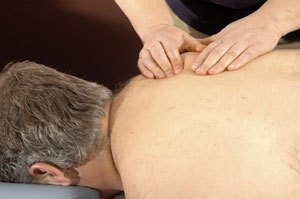
Massage
Massage is a form of touch therapy that involves applying pressure to the muscles or soft tissues to reduce stress and pain. A massage may bring on a "healing reaction". This can be a short time of mild discomfort that shows you that healing is going on. Be sure to ask what to expect after a session.
What to expect during a massage session
A massage therapist will ask you questions about your health to ensure a safe session. If you have pain, other symptoms, or a chronic illness, tell the therapist before the session begins.
Massage therapists may have private practices or work at fitness clubs, spas, or other public places. Some have portable massage chairs and offer short, low-cost neck and upper back massages at shops or public events. They are common at natural food stores in larger cities. Some massage therapists specialize in pregnancy and infant massage.
If you have a full-body massage in a private setting, you can usually either disrobe completely or keep your underwear on. You will be covered by a large towel, except for the parts of your body being worked on. Your private parts will be covered at all times.
Types of massage
There are many types of massage, each with different techniques and benefits. Some of them are:
- Swedish Massage – A common style of massage to relax and energize the body. Hand movements and several basic strokes are used to move the soft tissues of the body. The strokes all flow toward the heart, so this is a great way to improve circulation. An oil or lotion is used to allow smooth motion.
- Neuromuscular Massage – Uses more pressure to reach deeper tissue, tendons, and ligaments—this is called soft-tissue manipulation. This type of massage works with the body's nervous and musculoskeletal systems.
- Chi Nei Tsang – A Chinese system of healing abdominal massage using the Five Elements of Chinese medicine. Through a focus on the navel center, organ blockages are cleared and organs work together more efficiently.
- Tui Na – A form of Chinese Medical Massage using hand techniques, and passive and active stretching, to restore correct musculoskeletal balance and neuromuscular patterns, and to increase the flow of qi and blood.
Practitioner credentials for bodyworkers
There are many bodywork therapies—and as many types of training. Many therapists are trained to do massage, and then learn other types of bodywork to blend in their work. Ask each therapist about his or her training and techniques used.
LMT stands for licensed massage therapist. Requirements vary and licenses are granted by the states. CMT stands for certified massage therapist. Both LMT and CMT training includes 500 hours of practice. Professional groups like the American Massage Therapy Association (AMTA), the National Certification Board for Therapeutic Massage & Bodywork (NCBTMB), the American Organization for Bodywork Therapies of Asia™, and the Federation of State Massage Therapy Boards also have standards for their members. The latter has member boards in Alabama, Arizona, Arkansas, Delaware, Florida, Hawaii, Illinois, Iowa, Mississippi, New Hampshire, New Mexico, North Carolina, North Dakota, Oregon, Puerto Rico, South Carolina, Tennessee, Utah, Washington, Washington D.C., and West Virginia.
What a Massage Practitioner Says
"Some clients come for massage because they have pain in a certain area of their body, but leave with healing at a deeper level. In the calm mood of a massage session, the body has a chance to really relax and let go, and that release can relate to physical and emotional pain.
"Some people will make an inner discovery—as if letting go of some of the pain creates a mental or emotional shift, or an 'aha' moment. They feel different inside as the energy starts to flow again. There is a link between our minds, feelings, and the flow of our body's life force, or energy, and this flow affects our health. This is the holistic model—our bodies, minds, and spirits are interrelated.
"One patient says: 'I find that a massage about once a month helps with the dialysis blahs.'"
You can learn some massage techniques on your own or with a partner. Spending time with touch can be a step in your daily self-care. It's best to learn from a practitioner rather than a book.

