
Meditation
Do you chat with yourself in your mind as you move from one task to the next all day? Do you replay a past talk, worry, think about your finances, or long for a vacation? While we are having these chats with ourselves, our focus is split. We aren't fully paying attention to the moment when we think about the past or future. Meditation is a technique to stop the chatter and quiet the body and mind.
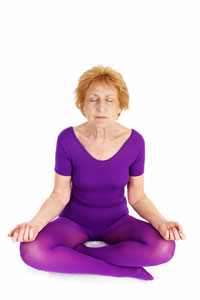
When you hear the word meditation, you might picture someone sitting cross-legged on a floor pillow, and wonder how you could sit that way. Most of us are not that flexible—and we start finding more comfortable ways to sit—on a chair or stool. Some people find they enjoy walking meditation.
Meditation practices
There are many forms of meditation and all intend to quiet the mind. Meditation has been linked to religious practices, like Zen, Buddhism, or the Vedic (Indian) practice of Transcendental Meditation. But meditation can also just be used to relax and enjoy its health benefits.
There are many ways to quiet the mind—which is easier said than done because our thoughts tend to disrupt the process. Some practices silently repeat a word, phrase, or sound. In others, you observe your breath as it moves in and out of your body. The technique seems less important than the repetition. Meditating for as little as 15 to 30 minutes each day can change our response to stress.
Many studies have shown that meditation slows the heart rate and breathing, lowers blood pressure, and reduces pain from muscle tension, headaches, or other causes. These changes create a restful feeling that helps restore the body. Meditation also creates relaxed, yet alert, brainwaves known as alpha waves. With practice, meditators say it is easier to stay calm during stressful life events. One patient says:
I learned breath control in birthing class. Well, it didn't help when I delivered my son. I was yelling, 'Get me the anesthesiologist! This breathing isn't working!' But now if I feel cramps coming on or other stress situations, it does help if I switch my concentration to breathing techniques. Breath technique was a large part of a class I took for COPD patients. Proper breathing can conserve energy.
Vipassana meditation
Vipassana, or insight meditation, is a Buddhist practice that may be done with or without other Buddhist teachings. It focuses on silently sitting or walking and observing each moment with awareness—but not judgment. Meditators calmly notice the mind as it changes from moment to moment, without reacting.
Transcendental meditation
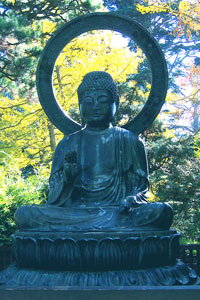
Transcendental meditation (TM) has roots in the Vedic, or Indian, religious tradition. This Eastern form of meditation was brought to the West by Maharishi Mahesh Yogi, an Indian spiritual teacher. Meditators are asked not to explain how to do TM, but do say they are given a simple Sanskrit sound (mantra) by a teacher. The sound—not a word—is silently repeated. When thoughts pop in, meditators return to repeating the mantra.
The National Institutes of Health (NIH) are doing research to study the effects of TM on reducing stress and heart problems in patients with heart disease. To learn TM, you need to take a class from someone who was trained by the Maharishi or one of his students.
Mindfulness meditation
Many hospitals and clinics now offer mind-body programs to reduce stress and pain. Sites in the U.S. for the Center for Mindfulness offer a Mindfulness-based Stress Reduction Program (MBSRP), developed in the early 1980s by Dr. Jon Kabat-Zinn, who studied Buddhist meditation and built its key principles into a course using the link between mind and body. In the U.S., 250 programs are sites for the Center for Mindfulness. The MBSRP is the largest academic medical center-based stress reduction program in the country.
The MBSRP is for people with certain health problems and others who want to improve their quality of life. It includes mindfulness meditation, a stress reduction guided meditation for the body, and yoga. Mindfulness meditation helps people become more mindful—better able to pay attention to what is happening each moment without needing to judge the experience.
The Inner Smile: A Taoist meditation
Our internal organs respond well, much as children do, when we give them our full attention. Because your mind is always busy, having it focus on your internal organs gives it something to do and helps quiet other intruding thoughts. If you don't know anatomy, it will help to look at an anatomy book when you start this meditation. Soon, with practice, you will feel your organs respond to your attention, which promotes deep relaxation.
The order for the "inner smile" follows the natural rhythms of the seasons.
Smile first to your lungs. The lungs are linked with the Fall. Imagine a shining white mist as you inhale. As you exhale, picture dark cloudy energy leaving your lungs and coming out through the pores of your skin. If you notice sadness, grief, or fatigue, all the better, for those are the negative emotions linked with the lungs. Breathe those emotions out and inhale courage and vitality. Feel your lungs open and soften. (NOTE: Even if you don't feel anything at first, pretend that you do. It will have the same effect!)
When you are ready, focus on the kidneys, which are linked with the cold and dark of Winter. Breathe in a dark blue/black mist and let it filter through the kidneys. Breathe out fear and doubt on a cloud of dark, tired, used-up energy. Breathe in gentleness and hopefulness, the virtues linked with the kidneys. Feel your kidneys smile back to you.
Next is the liver, linked with the fast, upward moving energy of Spring. As you smile deeply into your liver, imagine your body surrounded by a green mist. Breathe out any anger, frustration, irritability, or resentment. Breathe in kindness and generosity. Feel your liver soften and expand.
The heart, linked with the heat and growth of summer, follows the liver. Breathing in a red mist, feel your heart open and expand, releasing any impatience or hostility. Breathe in honor, respect, and love from the universe and let them fill your heart.
Now bring your smiling attention to your spleen and pancreas. Imagine a bright yellow mist around you and breathe it in as you release any worry. Breathe out dark, cloudy energy. As you inhale, let your spleen and pancreas absorb a sense of openness, fairness, and well-being, letting your whole body relax.
A real smile on your lips has an impact that affects your organs and your mood. You might notice that your smile is contagious, and you'll find others smiling back at you.
Generic technique for timeless healing
Dr. Herbert Benson offers a relaxation technique used at the Mind/Body Institute at Deaconess Medical Center, a Harvard Medical School teaching hospital. He says:
Only two basic steps need to be followed. You need to repeat a word, sound, prayer, phrase, or muscle action. When common, everyday thoughts intrude on your focus, just disregard them and return to your repetition.
You can use his process with words of your own choice—general terms of relaxation, like "peace", "calm", "relax", "love", nonsense syllables, or a spiritual phrase that speaks to you.
The process steps are:
- Pick a focus word or short phrase.
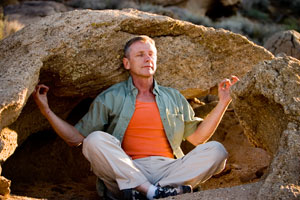
- Sit quietly in a comfortable position.
- Close your eyes.
- Relax your muscles.
- Breathe slowly and naturally, and as you do, repeat your focus word, phrase, or prayer silently to yourself as you exhale.
- Assume a passive attitude. Don't worry about how well you're doing. When other thoughts come to mind, just think, "Oh, well", and keep saying your word.
- Continue for 10 to 20 minutes.
- When you're done, don't stand up right away. Sit quietly for a minute or so with your eyes closed, letting other thoughts return. Then open your eyes and sit for another minute before rising.
- Practice once or twice each day.

