
Reprinted with permission from Baxter Healthcare Corporation, 2008
Peritoneal Dialysis
When most people think of dialysis, they think of being hooked up to a machine. And that is true for most kinds of dialysis. But peritoneal dialysis, or PD, doesn't have to use a machine. Instead, it uses part of your body as a filter.
The peritoneum is a membrane that lines the inside of your belly—it's like a bag, holding your internal organs. To do PD, this bag is filled up with a special fluid, called dialysate (dye-al'-i-sate). Wastes and extra water in the blood slowly flow into the dialysate.
After a few hours, the dialysate has all the wastes and water it can hold. Then the used fluid is drained out and clean fluid is put in.
How does dialysate get in and out of the peritoneum? Good question.
Reprinted with permission from
Baxter Healthcare Corporation, 2008
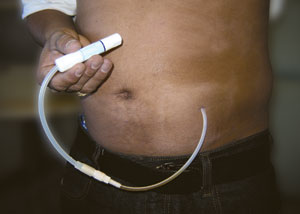
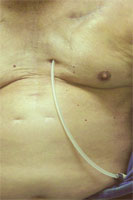
A minor surgery is done to put a soft, flexible plastic tube called a catheter (cath'-uh-ter) into your belly. Most PD catheters are placed in the lower abdomen. The other option is the less known "bathtub" or presternal placement. This places the catheter in the chest (avoiding the bra area for women) and the tip reaches down into the belly. Dialysate goes into the peritoneum through the catheter. The catheter stays in the body all the time and hangs out a few inches. It's covered up when it isn't being used.
Draining out dirty dialysate and putting in clean dialysate is called an exchange. Patients are trained to do PD exchanges themselves at home, at work, or when traveling. PD exchanges are painless.

